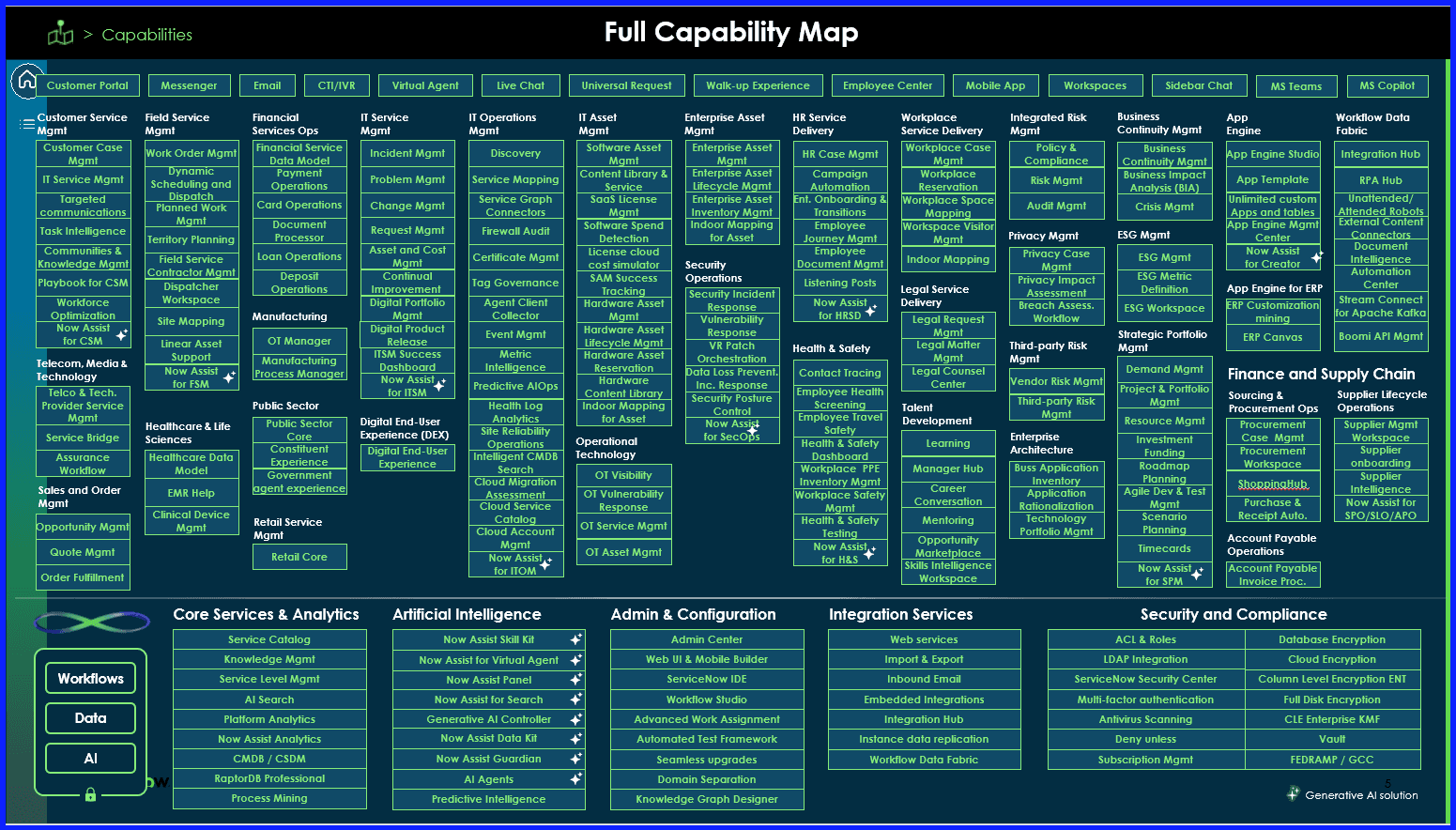
When most people think of ServiceNow, they picture an IT ticketing portal. But a look at the official ServiceNow Capability Map reveals a vastly different reality. Today, ServiceNow is a comprehensive enterprise operating system designed to connect fragmented departments, automate manual tasks, and deliver frictionless experiences.
Because the ecosystem is so vast, understanding what you already own - and what you could be leveraging - is critical to maximizing your ROI. In this three-part series, we are breaking down every single module on the capability map.
To help organizations understand exactly what they own - and what they are missing out on - we are breaking down every module on the ServiceNow capability map. For each module, we will explore its main purpose, how it functions mechanically, and the specific business problem it solves.
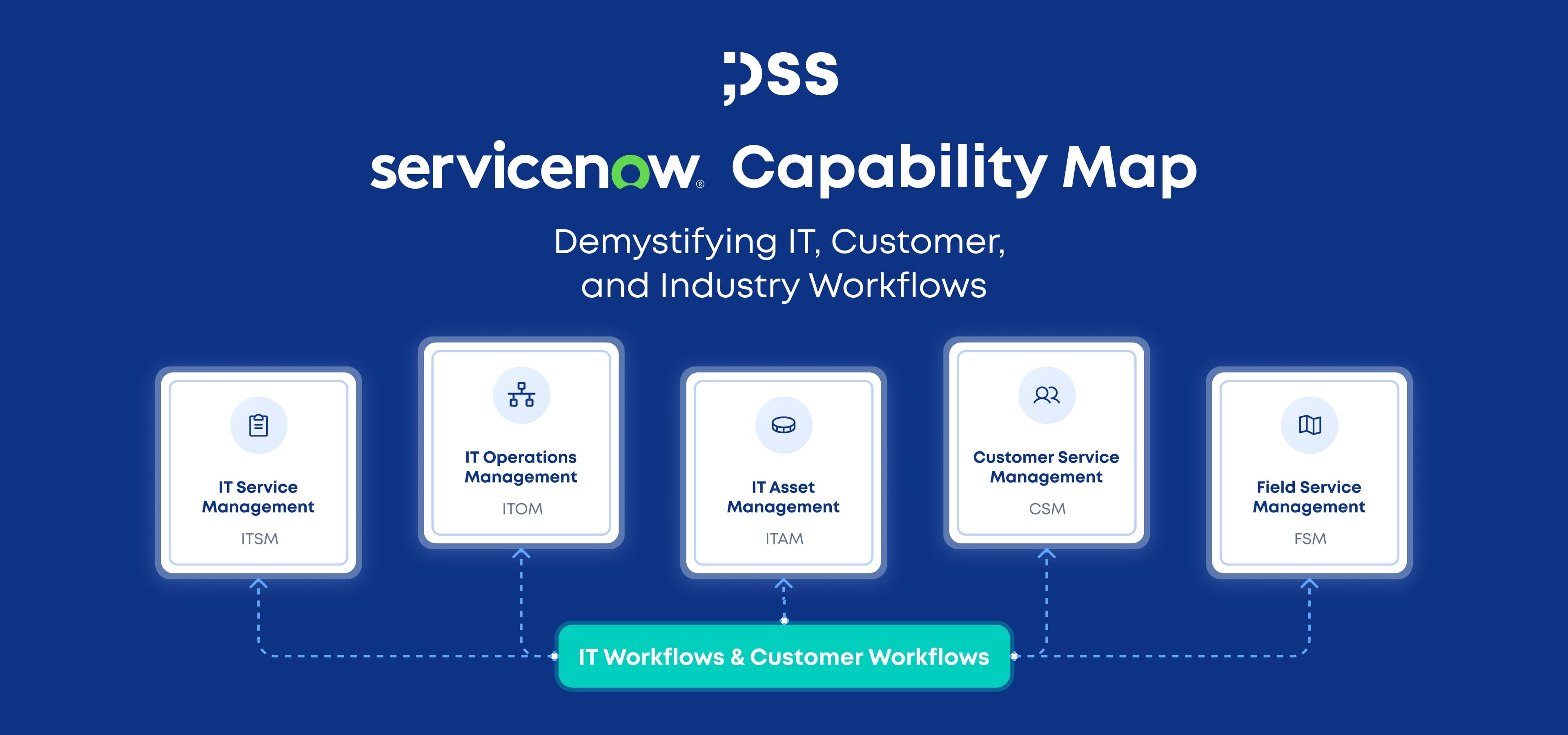
Part 1 covers the foundational pillars: IT Workflows and Customer Workflows.
1. IT Service Management (ITSM)
The core engine for delivering, managing, and optimizing internal technology services.
- Incident Management
- Problem Management
- Change Management
- Request Management
- Asset and Cost Management
- Continual Improvement
- Digital Portfolio Management
- Digital Product Release
- ITSM Success Dashboard
- Now Assist for ITSM
Incident Management
- Main Purpose: To restore normal technology service operation as quickly as possible.
- How it Functions: Logs, categorizes, prioritizes, and routes user-reported IT disruptions to the appropriate technical team for resolution.
- The Problem it Solves: Eliminates chaotic, untracked emails when technology breaks, minimizing employee downtime and business impact.
Problem Management
- Main Purpose: To identify and resolve the root cause of recurring IT issues.
- How it Functions: Groups multiple similar incidents together and initiates a formal investigation process to find a permanent fix rather than a temporary workaround.
- The Problem it Solves: Stops the IT helpdesk from fixing the exact same issue over and over again, reducing overall ticket volume.
Change Management
- Main Purpose: To ensure that updates to IT infrastructure are made smoothly and safely.
- How it Functions: Enforces an approval and testing workflow before new code, server patches, or system updates are deployed to the live environment.
- The Problem it Solves: Prevents self-inflicted outages caused by unauthorized or poorly tested changes to critical systems.
Request Management
- Main Purpose: To handle routine employee requests for new hardware, software, or access.
- How it Functions: Provides an Amazon-like shopping cart experience (Service Catalog) where users can order items that trigger automated approval and fulfillment workflows.
- The Problem it Solves: Replaces manual procurement processes, ensuring employees get the tools they need quickly and with proper managerial oversight.
Asset and Cost Management
- Main Purpose: To track the financial lifecycle of IT services.
- How it Functions: Connects IT assets and services to their financial costs, tracking depreciation, vendor spend, and total cost of ownership.
- The Problem it Solves: Stops IT from being a "black hole" of spending by providing executives with clear data on what technology actually costs to run.
Continual Improvement
- Main Purpose: To systematically track and manage service improvement initiatives.
- How it Functions: Creates a centralized register to log improvement ideas, assign tasks, and measure the ROI of process changes over time.
- The Problem it Solves: Prevents good ideas from getting lost in the shuffle and ensures IT is constantly evolving rather than stagnating.
Digital Portfolio Management
- Main Purpose: To manage IT services as business products.
- How it Functions: Gives service owners a single workspace to view the health, performance, roadmap, and financials of their specific application or service.
- The Problem it Solves: Shifts the IT mindset from "managing servers" to "managing products" that deliver measurable value to the business.
Digital Product Release
- Main Purpose: To coordinate the release of new digital products across the enterprise.
- How it Functions: Integrates with DevOps tools to orchestrate and track the deployment of software releases, ensuring compliance and alignment with change management.
- The Problem it Solves: Bridges the gap between fast-moving agile development teams and the strict governance required by enterprise IT operations.
ITSM Success Dashboard
- Main Purpose: To measure the effectiveness of the ITSM implementation.
- How it Functions: Aggregates KPI data (like mean time to resolve, self-service deflection rates) into executive-level visual dashboards.
- The Problem it Solves: Proves the ROI of the ServiceNow platform to leadership by quantifying improvements in IT efficiency.
Now Assist for ITSM
- Main Purpose: To supercharge IT support with Generative AI.
- How it Functions: Uses native AI to summarize long ticket threads, generate resolution notes, and draft knowledge base articles automatically.
- The Problem it Solves: Drastically reduces the administrative burden on IT agents, allowing them to focus on fixing complex technical problems rather than typing summaries.
2. IT Operations Management (ITOM)
The visibility and proactive intelligence layer for network infrastructure and cloud environments.
- Discovery
- Service Mapping
- Service Graph Connectors
- Firewall Audit
- Certificate Management
- Tag Governance
- Agent Client Collector
- Event Management
- Metric Intelligence & Predictive AIOps
- Health Log Analytics
- Site Reliability Operations
- Intelligent CMDB Search
- Cloud Management (Migration, Catalog, Account Mgmt)
Discovery
- Main Purpose: To find and identify every piece of hardware and software on the network.
- How it Functions: Scans IP ranges without requiring agents, pulling detailed configuration data about servers, routers, and databases into the Configuration Management Database (CMDB).
- The Problem it Solves: Eliminates blind spots. IT cannot secure or fix systems they do not know exist.
Service Mapping
- Main Purpose: To understand how isolated tech components work together.
- How it Functions: Maps the exact relationship between underlying infrastructure and the business services they support (e.g., showing exactly which database, server, and firewall power the "Payroll Application").
- The Problem it Solves: When a server goes down, IT instantly knows which business applications—and which users—are affected, rather than guessing.
Service Graph Connectors
- Main Purpose: To ingest data from third-party systems seamlessly.
- How it Functions: Uses certified integrations to pull data from external tools (like SCCM, AWS, or SolarWinds) into the ServiceNow CMDB while maintaining data integrity.
- The Problem it Solves: Prevents dirty, duplicated data from polluting the CMDB when relying on multiple external monitoring tools.
Firewall Audit
- Main Purpose: To maintain the security and compliance of network perimeters.
- How it Functions: Automates the process of reviewing firewall rules, identifying redundant, overly permissive, or expired rules.
- The Problem it Solves: Prevents security breaches caused by outdated or misconfigured firewall settings that are often too complex to manage manually.
Certificate Management
- Main Purpose: To track and renew digital certificates securely.
- How it Functions: Discovers SSL/TLS certificates across the network, tracks their expiration dates, and triggers automated renewal workflows.
- The Problem it Solves: Prevents catastrophic, highly public application outages caused simply by someone forgetting to renew a security certificate.
Tag Governance
- Main Purpose: To ensure consistent categorization of cloud and on-premise resources.
- How it Functions: Audits infrastructure tags (like environment, owner, or cost center) to ensure they follow company policies, auto-remediating those that do not.
- The Problem it Solves: Prevents cloud billing chaos by ensuring every virtual machine is correctly labeled and billed to the right department.
Agent Client Collector
- Main Purpose: To gather deep telemetry directly from user endpoints.
- How it Functions: A lightweight agent installed on laptops and servers that feeds real-time performance and event data back to ServiceNow.
- The Problem it Solves: Allows IT to troubleshoot issues on a specific user's machine without interrupting the user or relying on network-level scanning.
Event Management
- Main Purpose: To consolidate and filter alerts from various monitoring tools.
- How it Functions: Ingests thousands of alerts from tools like Datadog or Splunk, filters out the noise, and groups related alerts into a single actionable incident.
- The Problem it Solves: Stops "alert fatigue," where IT engineers ignore monitoring alarms because there are simply too many false positives.
Metric Intelligence & Predictive AIOps
- Main Purpose: To predict outages before they happen.
- How it Functions: Uses machine learning to establish a baseline of normal system performance, identifying anomalies (like a sudden CPU spike) and triggering alerts before a hard crash occurs.
- The Problem it Solves: Shifts IT from a reactive "firefighting" model to a proactive model, fixing systems before the end-user ever notices a degradation in service.
Health Log Analytics
- Main Purpose: To identify the root cause of complex system behaviors.
- How it Functions: Ingests and analyzes massive volumes of raw log data from applications and servers to spot hidden errors that standard monitoring tools miss.
- The Problem it Solves: Reduces the time engineers spend manually combing through thousands of lines of text logs during a major outage.
Site Reliability Operations
- Main Purpose: To bridge IT operations and software engineering.
- How it Functions: Provides a workspace for Site Reliability Engineering (SRE) teams to manage microservices, track error budgets, and align with DevOps practices.
- The Problem it Solves: Ensures modern, cloud-native applications are supported with the same rigor as traditional legacy systems.
Intelligent CMDB Search
- Main Purpose: To make finding infrastructure data effortless.
- How it Functions: Allows users to query the massive configuration database using natural language (e.g., "Show me all Windows 2016 servers in London").
- The Problem it Solves: Removes the need for users to understand complex database query languages just to find basic infrastructure information.
Cloud Management (Migration, Catalog, Account Mgmt)
- Main Purpose: To govern and orchestrate multi-cloud environments.
- How it Functions: Assesses readiness for cloud migration, provides a standardized catalog for developers to spin up cloud resources, and manages billing across AWS, Azure, and GCP.
- The Problem it Solves: Prevents "shadow IT" by giving developers a fast, approved way to get cloud resources without bypassing corporate security policies.
3. IT Asset Management (ITAM)
The financial and compliance engine for hardware and software.
- Software Asset Management (SAM) & SaaS License Mgmt
- Software Spend Detection & License Cloud Cost Simulator
- Hardware Asset Management (Lifecycle & Reservation)
- Indoor Mapping for Asset
Software Asset Management (SAM) & SaaS License Mgmt
- Main Purpose: To optimize software spending and ensure legal compliance.
- How it Functions: Compares the software licenses you have purchased against what is actually installed and being used on the network or accessed via web browsers (SaaS).
- The Problem it Solves: Recoups wasted money by identifying inactive software subscriptions that can be canceled, and prevents massive fines during vendor audits.
Software Spend Detection & License Cloud Cost Simulator
- Main Purpose: To uncover hidden software costs and predict future expenses.
- How it Functions: Analyzes financial transaction data (like corporate credit card expenses) to find software bought outside of IT, and simulates the cost of moving on-premise licenses to the cloud.
- The Problem it Solves: Gives finance teams a completely accurate picture of enterprise software spend, cutting off unauthorized expensed subscriptions.
Hardware Asset Management (Lifecycle & Reservation)
- Main Purpose: To track physical devices from purchase to disposal.
- How it Functions: Automates workflows for receiving hardware, deploying it to users, tracking it while in use, and ensuring secure data wiping upon retirement.
- The Problem it Solves: Prevents the expensive loss of company laptops and servers, and ensures compliance with environmental and data security regulations during disposal.
Indoor Mapping for Asset
- Main Purpose: To locate physical assets geographically.
- How it Functions: Integrates floor plans into the platform, visually displaying exactly where a server, printer, or specialized piece of equipment is located within a building.
- The Problem it Solves: Saves technicians hours of wandering around massive corporate campuses or data centers trying to locate a specific piece of broken hardware.
4. Customer Service Management (CSM)
Connecting front-line customer support to the departments that actually fix the issues.
- Customer Case Management
- Targeted Communications
- Task Intelligence & Now Assist for CSM
- Communities & Knowledge Management
- Playbook for CSM
- Workforce Optimization for CSM
Customer Case Management
- Main Purpose: To handle complex external customer inquiries and issues.
- How it Functions: Routes cases based on agent skill and availability, providing a unified workspace that links the customer's issue directly to internal IT, engineering, or finance tasks.
- The Problem it Solves: Eliminates the "black hole" of customer service where agents have to manually email other departments to get a customer's problem fixed.
Targeted Communications
- Main Purpose: To proactively inform customers of known issues.
- How it Functions: Identifies which specific customers are impacted by an outage or defect and automatically sends them emails or portal notifications.
- The Problem it Solves: Deflects hundreds of incoming support calls during a major outage by telling the customer "we know it's broken, and we are fixing it" before they have a chance to complain.
Task Intelligence & Now Assist for CSM
- Main Purpose: To speed up resolution using AI.
- How it Functions: Analyzes incoming customer emails or chats to automatically categorize the issue, extract key data, summarize the history, and draft a response for the agent.
- The Problem it Solves: Removes the manual triage process, ensuring urgent cases get to the right specialist instantly while reducing agent burnout.
Communities & Knowledge Management
- Main Purpose: To enable customer self-service and peer support.
- How it Functions: Provides external portals where customers can read official help articles or ask questions in forums answered by other users or moderators.
- The Problem it Solves: Drastically lowers support costs by empowering customers to solve their own minor issues without ever opening a formal support ticket.
Playbook for CSM
- Main Purpose: To standardize the handling of complex, multi-step customer issues.
- How it Functions: Provides agents with a visual, step-by-step guide directly on their screen, ensuring they follow regulatory or company procedures for specific case types (like processing a warranty claim).
- The Problem it Solves: Reduces onboarding time for new agents and ensures consistent, error-free service delivery regardless of who answers the phone.
Workforce Optimization for CSM
- Main Purpose: To manage agent schedules, skills, and performance.
- How it Functions: Analyzes historical case volumes to forecast staffing needs, automatically schedules shifts, and identifies skill gaps for agent coaching.
- The Problem it Solves: Prevents understaffing during peak support hours and provides managers with data to objectively evaluate agent performance.
5. Field Service Management (FSM)
Orchestrating work done on location, away from the desk.
- Work Order Management
- Dynamic Scheduling, Dispatch & Dispatcher Workspace
- Territory Planning & Site Mapping
- Planned Work Management
- Field Service Contractor Management
- Linear Asset Support
Work Order Management
- Main Purpose: To define and track tasks requiring physical intervention.
- How it Functions: Translates a customer case or IT alert into a specific work order detailing what needs to be fixed, where it is, and what skills are required to fix it.
- The Problem it Solves: Ensures that field work is formally tracked and integrated into the broader customer or IT record, rather than existing on paper clipboards.
Dynamic Scheduling, Dispatch & Dispatcher Workspace
- Main Purpose: To get the right technician to the right place efficiently.
- How it Functions: Uses algorithms to match work orders to technicians based on their location, available inventory, schedule, and specific skill set, presented on a map-based workspace.
- The Problem it Solves: Eliminates the logistical nightmare of manual scheduling, reducing technician travel time and increasing the number of jobs completed per day.
Territory Planning & Site Mapping
- Main Purpose: To optimize the geographic distribution of the workforce.
- How it Functions: Allows managers to draw and adjust service regions on a map to balance the workload across the team and visualize customer sites.
- The Problem it Solves: Prevents scenarios where one technician is overloaded while another in a neighboring zip code sits idle.
Planned Work Management
- Main Purpose: To automate routine, preventative maintenance.
- How it Functions: Automatically generates work orders on a set schedule (e.g., quarterly HVAC inspections or monthly ATM servicing).
- The Problem it Solves: Ensures physical infrastructure is maintained proactively, preventing costly emergency breakdowns.
Field Service Contractor Management
- Main Purpose: To seamlessly integrate third-party vendors into operations.
- How it Functions: Allows external contractors to receive, update, and close work orders within your ServiceNow instance without giving them access to sensitive internal data.
- The Problem it Solves: Maintains complete visibility and quality control over work even when it is outsourced to external companies.
Linear Asset Support
- Main Purpose: To manage work on continuous infrastructure.
- How it Functions: Routes technicians to precise locations on infrastructure that spans long distances, like pipelines, railway tracks, or fiber optic cables.
- The Problem it Solves: Solves the difficulty of dispatching a worker to "mile marker 42" instead of a traditional street address.
FAQ
What is the ServiceNow Capability Map?
The ServiceNow Capability Map is a visual overview of every module available on the ServiceNow platform, organized by workflow area. It helps organizations understand what they own and what they could be leveraging to maximize ROI.
What does Part 1 of the ServiceNow Capability Map series cover?
Part 1 covers the foundational pillars: IT Service Management (ITSM), IT Operations Management (ITOM), IT Asset Management (ITAM), Customer Service Management (CSM), and Field Service Management (FSM).
What is IT Service Management (ITSM) in ServiceNow?
ITSM in ServiceNow is the core engine for delivering and managing internal technology services. It includes Incident, Problem, Change, and Request Management, along with AI-powered tools like Now Assist for ITSM.
What is IT Operations Management (ITOM) in ServiceNow?
ITOM provides visibility and proactive intelligence across network infrastructure and cloud environments. Key modules include Discovery, Service Mapping, Event Management, and AIOps.
What is IT Asset Management (ITAM) in ServiceNow?
ITAM is the financial and compliance engine for hardware and software. It includes Software Asset Management (SAM), Hardware Asset Management, and SaaS License Management to control costs and ensure compliance.
What is Customer Service Management (CSM) in ServiceNow?
CSM connects front-line customer support directly to the departments that resolve issues. It includes Customer Case Management, AI-powered Task Intelligence, and Communities and Knowledge Management.
What is Field Service Management (FSM) in ServiceNow?
FSM orchestrates on-site work by managing work orders, dynamic scheduling, and dispatch. It ensures the right technician reaches the right location with the right skills and equipment.
How does Now Assist enhance ITSM and CSM in ServiceNow?
Now Assist uses generative AI to summarize ticket threads, draft responses, generate knowledge articles, and intelligently triage cases, significantly reducing manual work for both IT agents and customer service teams.
How can DSS help with ServiceNow implementation?
DSS is an official ServiceNow partner offering consulting, implementation, and managed services. Our certified team helps organizations configure and optimize any module across the ServiceNow Capability Map.
Where can I learn more about ServiceNow modules and their ROI?
You can use the DSS ServiceNow ROI Calculator to estimate the business value of your investment, or contact our team for a personalized assessment of your ServiceNow capabilities.


