As organizations rapidly transition from conversational AI to autonomous, agentic AI, the enterprise technology landscape is undergoing a monumental shift. AI agents are no longer just answering questions; they are executing complex workflows, accessing sensitive databases, and communicating with one another to resolve enterprise-wide issues. However, this evolution brings a critical challenge: visibility and governance. How does an enterprise maintain control when hundreds of autonomous AI agents are executing tasks across HR, IT, Customer Service, and external cloud platforms?
Enter the ServiceNow AI Control Tower. Introduced as a cornerstone of ServiceNow's evolving AI strategy (and heavily expanded in recent releases, including the Australia release), the AI Control Tower is a centralized command and control platform. It allows organizations to govern, manage, secure, and optimize the use of AI agents, models, and workflows from a single, unified interface.
Whether you are managing ServiceNow-native generative AI or third-party Large Language Models (LLMs) via hyperscalers like AWS, Microsoft, and NVIDIA, the AI Control Tower serves as the critical abstraction layer. It ensures that your AI operates safely, efficiently, and in strict alignment with business compliance standards.
The Core Problem: The Rise of Shadow AI
Before diving into the technical mechanics of the Control Tower, it is vital to understand the problem it solves. Historically, as new technologies emerged, IT departments battled "Shadow IT" — unauthorized software used by employees without central oversight. Today, that problem has evolved into "Shadow AI."
Individual departments are spinning up AI models, deploying custom agents, and connecting them to enterprise data lakes without standardized security protocols. This creates massive vulnerabilities:
- Data Privacy Risks: AI agents might access and expose Personally Identifiable Information (PII) if Role-Based Access Control (RBAC) is not strictly enforced.
- Compliance Violations: Without an audit trail, organizations cannot prove to regulatory bodies that their AI models are free from bias or operating within legal frameworks (like the NIST AI Risk Management Framework).
- Wasted Resources: Redundant AI tools are procured by different departments, leading to uncontrolled costs and overlapping functionalities.
The ServiceNow AI Control Tower acts as the antidote to Shadow AI by forcing all AI initiatives out of the shadows and into a highly structured, governed, and observable lifecycle.
What is the ServiceNow AI Control Tower?
At its core, the ServiceNow AI Control Tower is an intelligent hub designed to connect AI strategy with governance, management, and operational performance. It provides a single pane of glass for enterprise architects, security teams, and business leaders to monitor the entirety of their AI ecosystem.
Rather than treating AI as a fragmented set of tools, the Control Tower treats AI assets — models, agents, datasets, and prompts — as critical infrastructure. It bridges the gap between the speed of AI innovation and the rigid requirements of enterprise risk management. By leveraging ServiceNow's powerful workflow engine, the Control Tower automates the entire lifecycle of an AI agent, from its initial ideation and approval to its deployment, monitoring, and eventual retirement.
Key Capabilities and Features
To truly understand the value of the platform, we must break down its core capabilities into five distinct pillars.
1. Unified AI Inventory and Discovery
The foundation of governance is visibility. You cannot secure what you cannot see. The AI Control Tower automatically discovers and catalogs all AI assets across the environment. It populates this data directly into the ServiceNow Configuration Management Database (CMDB), creating new Configuration Item (CI) classes specifically for AI.
This inventory tracks:
- Agent Metadata: The purpose, owner, and dependencies of every AI agent.
- AI Models & Datasets: The underlying LLMs being used and the specific datasets they were trained on.
- Integration Mappings: A visual map of how AI agents interact with enterprise systems and other agents.
2. Intelligent AI Orchestration and the Agent Fabric
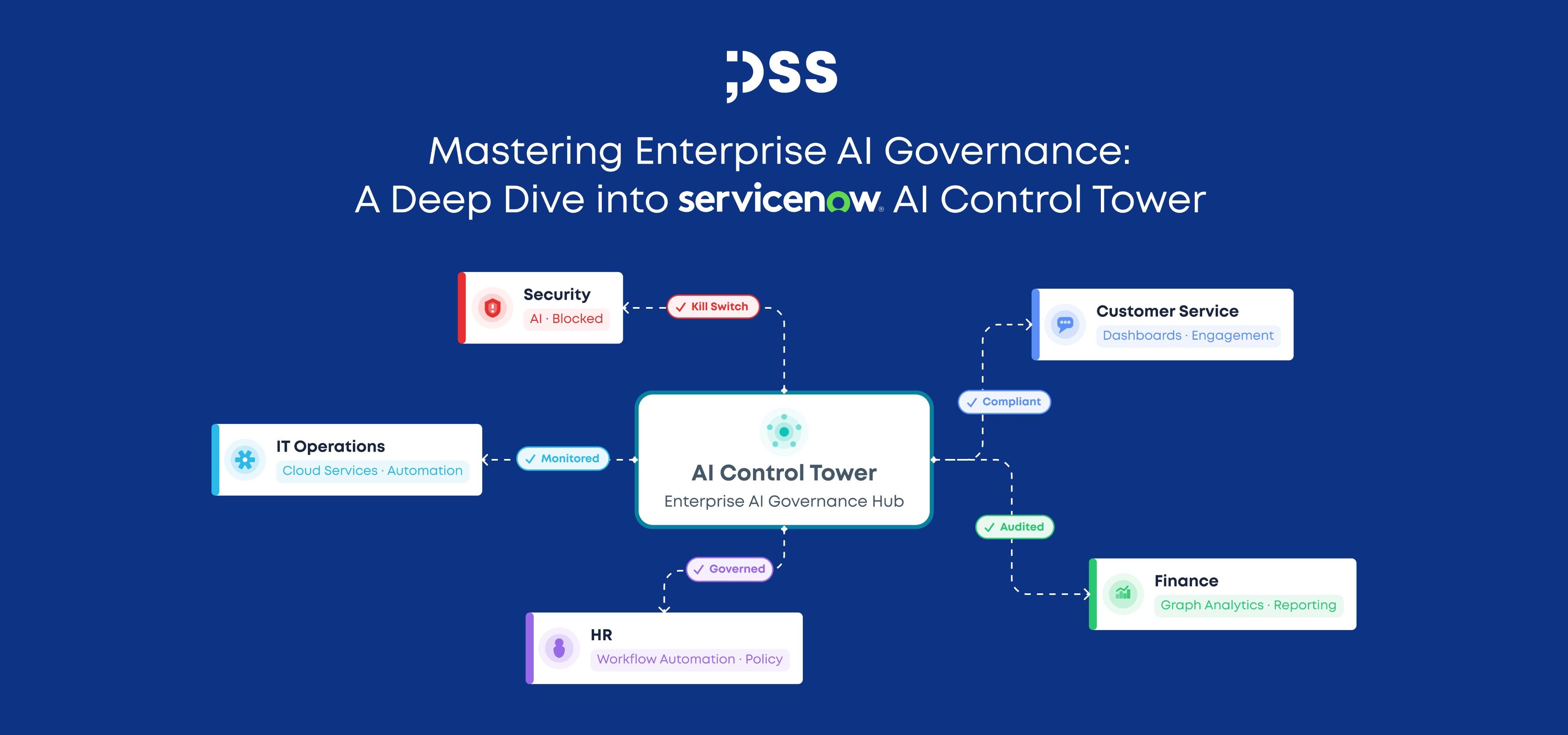
As enterprises deploy multiple AI agents, these agents need to work together. The Control Tower acts as the management layer for the AI Agent Fabric, a communication layer that allows native and third-party AI agents to collaborate.
For example, a Customer Service AI agent might receive a ticket regarding a billing error. Through the Agent Fabric, it can securely communicate with a Finance AI agent to verify the transaction, and then an IT AI agent to update the user's account status. The Control Tower oversees this orchestration, ensuring that agents only pass data they are authorized to share, optimizing resource allocation, and preventing infinite loops in agent-to-agent communication.
3. Governance, Risk, and Compliance (GRC) Automation
The "control" in Control Tower is heavily driven by its deep integration with ServiceNow's GRC modules. Deploying an AI agent is no longer a simple toggle switch; it is a governed process.
When a team proposes a new AI agent, the Control Tower automates the approval workflow. It routes the request to Legal to check for intellectual property concerns, to Security to validate data access, and to Ethics committees to ensure the model's guardrails prevent biased outputs.
Furthermore, the system continuously evaluates models against predefined LLM guardrail policies. It monitors for data integrity incidents, agent goal deviation, and the accidental generation of offensive content or sensitive data.
4. Deep Observability and Security (The "Kill Switch")
Agentic AI introduces run-time risks. What happens if an AI agent hallucinates or goes "off script" and begins taking unauthorized actions in a production database?
Through recent expansions (including the acquisition of Traceloop), the AI Control Tower provides deep observability into AI behavior at runtime. It gives security teams visibility into how agents reason, the logic behind their decisions, and when they deviate from their intended goals.
Crucially, the platform includes real-time security enforcement. Through integrations with identity access platforms (like Veza) and cyber exposure management tools (like Armis), the Control Tower monitors agent permissions. If an agent attempts to execute a command beyond its scoped least-privilege permissions, the Control Tower detects the anomaly and provides an instantaneous "Kill Switch" to shut the agent down before damage occurs.
5. ROI Measurement and Value Realization
AI is a massive financial investment. The Control Tower shifts the conversation from technical metrics to business outcomes. It features dynamic dashboards that track:
- Usage Analytics: How often an AI agent is triggered and its success rate.
- Cost Tracking: Monitoring token consumption and infrastructure costs across various LLM providers.
- Productivity Gains: Calculating the hours of human labor saved by automated AI workflows.
This allows IT leaders to prove the Return on Investment (ROI) of their AI initiatives and make data-driven decisions about which agents to scale and which to retire.
How it Works Under the Hood: Technical Architecture
For solution architects, the true brilliance of the AI Control Tower lies in how it leverages existing ServiceNow architectural concepts and applies them to artificial intelligence.
The CMDB as the Source of Truth
By treating AI systems, Agentic AI, Datasets, and Model Context Protocol (MCP) servers as CIs within the CMDB, ServiceNow applies decades of mature IT Service Management (ITSM) principles to AI. You can create formal Change Requests for deploying a new dataset or an Offboarding Request to retire an outdated AI model. This means AI lifecycle management does not require learning a completely new operational paradigm; it utilizes the same ITIL-aligned processes enterprises already trust.
Model Context Protocol (MCP) Servers and Guardrails
Modern AI agents interact with enterprise environments through Model Context Protocol (MCP) servers. The Control Tower monitors all MCP server access by the AI Gateway. It provides out-of-the-box charts tracking authorized access attempts, failed access attempts, and the specific clients connecting to these servers.
Administrators can customize their AI Asset Security Score by weighting different LLM guardrail categories. If an agent attempts an action that triggers a prompt injection alert or a sensitive data leak detection, the system logs the incident, blocks the action, and dynamically lowers the security score of that specific AI asset, triggering a review.
Cross-Platform Integrations
ServiceNow knows it will not be the sole provider of enterprise AI. Therefore, the Control Tower is designed to be agnostic. It features deepened integrations with AWS, Microsoft, and the NVIDIA Enterprise AI Factory. This allows organizations to run custom models on secure NVIDIA infrastructure while relying on ServiceNow to handle the orchestration, policy enforcement, and compliance reporting at the application layer.
Deployment and Licensing Models
To accommodate different stages of AI maturity, ServiceNow has structured its AI platform experience into distinct licensing tiers:
- Foundation: Provides the essential AI basics to deliver insights and standard visibility.
- Advanced: Unlocks deeper AI capabilities designed to boost productivity across specific, high-value use cases.
- Prime: The fully unlocked tier, allowing organizations to act autonomously with all AI assets, create their own custom agents, and fully utilize the orchestration and deep governance of the AI Control Tower.
For developers and administrators looking to activate these features, the AI Control Tower can be installed directly from the ServiceNow Store via specific plugins (such as com.sn_ai_disc), which enable the necessary AI connection interfaces and Service Graph Connectors.
Conclusion: The Future of AI is Governed
The era of experimenting with isolated AI chatbots is over. As organizations move toward widespread, agentic AI — where software acts autonomously on behalf of humans — the limiting factor will no longer be intelligence; it will be trust.
The ServiceNow AI Control Tower addresses this exact bottleneck. By providing a centralized abstraction layer that combines discovery, governance, security, and observability, it allows enterprises to scale their AI ambitions safely. It ensures that every AI action is documented, every agent is operating within its defined permissions, and every AI investment is actively contributing to the organization's bottom line. For the modern enterprise architect, mastering the AI Control Tower is not just an option — it is an absolute necessity for surviving the next decade of digital transformation.
FAQ
What is the ServiceNow AI Control Tower?
It is a centralized command and control platform that allows organizations to govern, manage, secure, and optimize AI agents, models, and workflows from a single, unified interface — covering both ServiceNow-native AI and third-party LLMs.
What is Shadow AI and how does the Control Tower address it?
Shadow AI refers to AI models and agents deployed by individual departments without central oversight, creating privacy, compliance, and cost risks. The Control Tower counters it with automatic discovery and a unified AI inventory in the CMDB, bringing every AI asset into a governed lifecycle.
Can the AI Control Tower govern third-party AI models?
Yes. The platform is designed to be agnostic, with deep integrations with AWS, Microsoft, and the NVIDIA Enterprise AI Factory, handling orchestration, policy enforcement, and compliance reporting at the application layer.
What is the AI "Kill Switch"?
It is a real-time security control. If an agent attempts to execute a command beyond its scoped least-privilege permissions, the Control Tower detects the anomaly and can instantly shut the agent down before damage occurs.
What licensing tiers are available?
ServiceNow structures its AI platform experience into three tiers: Foundation (essential AI basics), Advanced (deeper capabilities for high-value use cases), and Prime (full autonomy, custom agents, and the complete orchestration and governance of the AI Control Tower).
How can DSS help with ServiceNow implementation?
DSS is an official ServiceNow partner offering consulting, implementation, and managed services. Our certified team helps organizations configure and optimize any module across the ServiceNow platform, including the AI Control Tower.