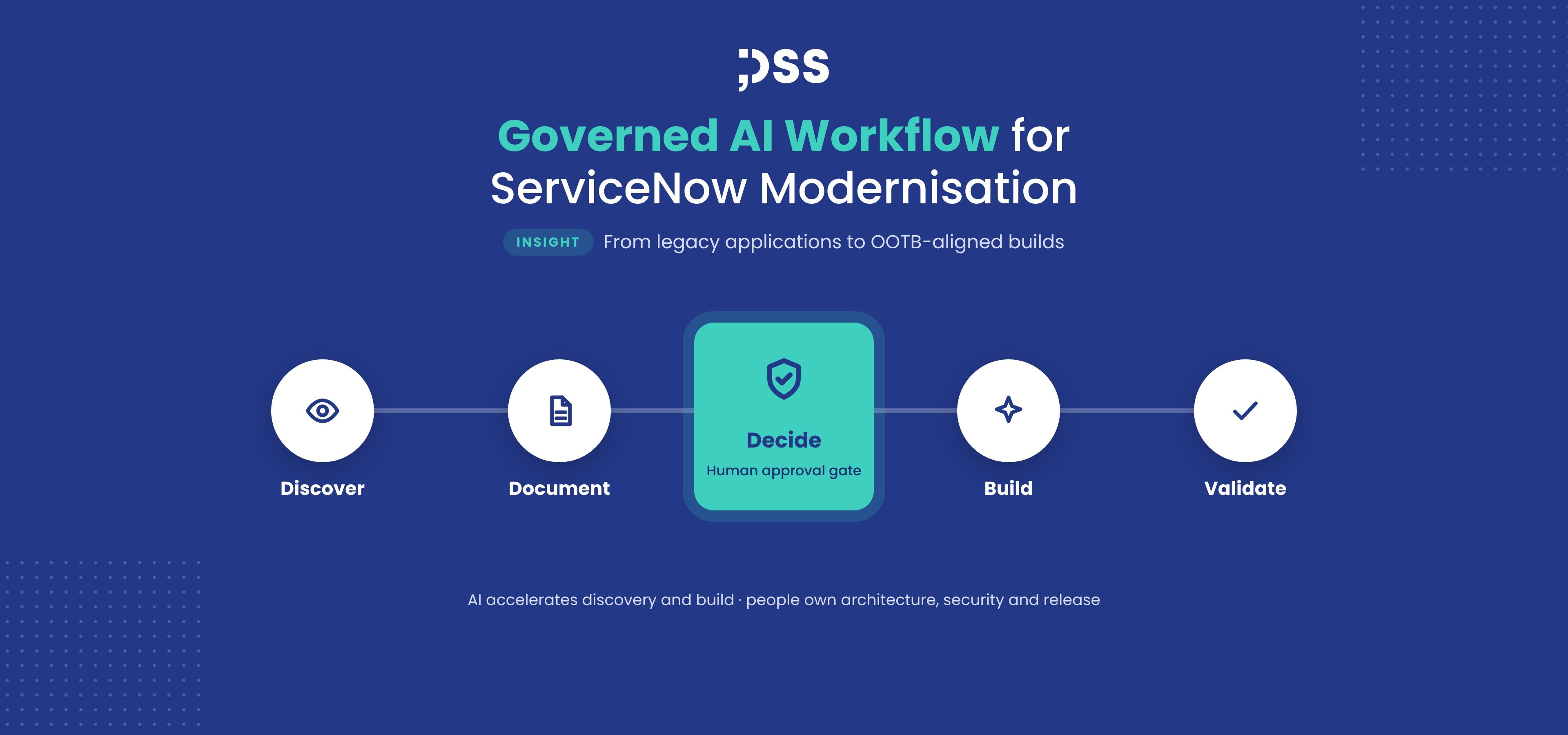
AI can accelerate both application discovery and development in ServiceNow. The value appears when those capabilities are connected by approved documentation, OOTB-first decisions and human validation. This article sets out a practical five-stage approach to using AI for ServiceNow discovery, documentation, out-of-the-box (OOTB) gap analysis, controlled build and migration.
Why Documentation Comes First
Modernising a legacy ServiceNow application is rarely blocked by the ability to create another table or flow. The harder problem is knowing what the current application does, why each customisation exists and whether the platform already offers a better supported capability.
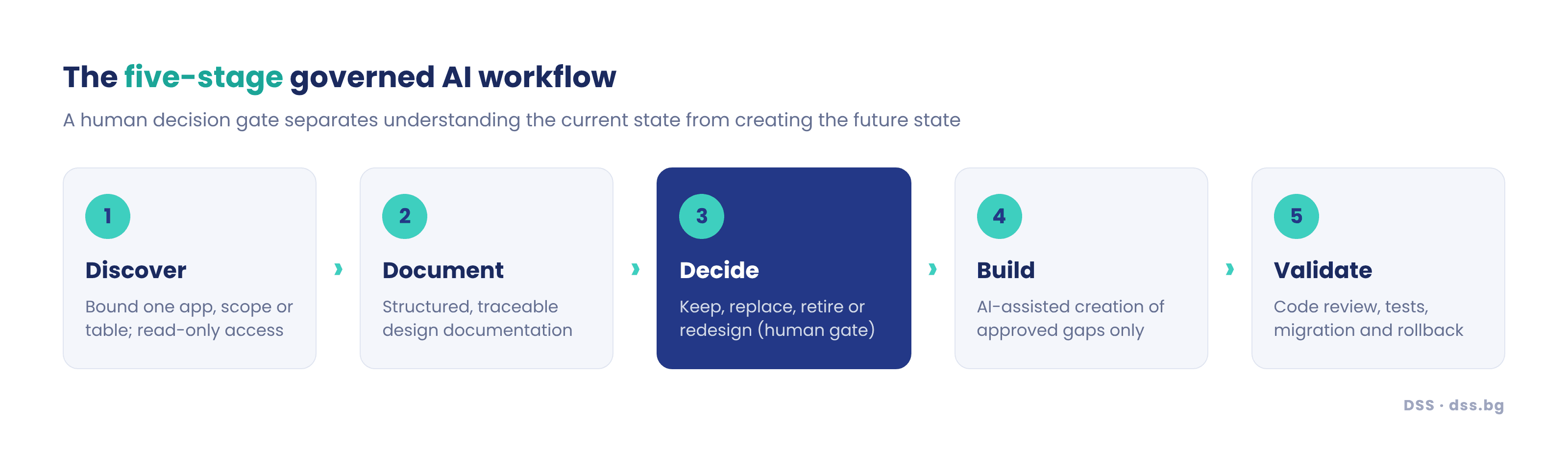
Generative AI can help with both discovery and delivery, but treating those as one open-ended task is risky. A safer pattern separates the work into five governed stages, with a human decision gate between understanding the current state and creating the future state.
The Five-Stage Workflow
The workflow runs through five stages: Discover, Document, Decide, Build and Validate.
1. Bound Discovery Before Asking AI to Analyse
Select one application, scope or table. Define exactly which configuration sources the agent may read and which data must remain excluded. During discovery, the agent should not create or change records. This boundary makes the output easier to verify and reduces the chance that analysis turns into uncontrolled implementation. Our ServiceNow AI agent guide explains how to give agents a clear, limited purpose.
2. Generate Structured Documentation, Not Just a Component List
Useful discovery output connects platform evidence to business meaning. It should describe the data model, process flow, server and client logic, automation, security, integrations and operational components. Each conclusion should be traceable to the source configuration so reviewers can confirm it.
- Functional and technical design summaries.
- Data-model and process-flow descriptions.
- Security, dependency and integration views.
- Migration mapping, assumptions, risks and test scenarios.
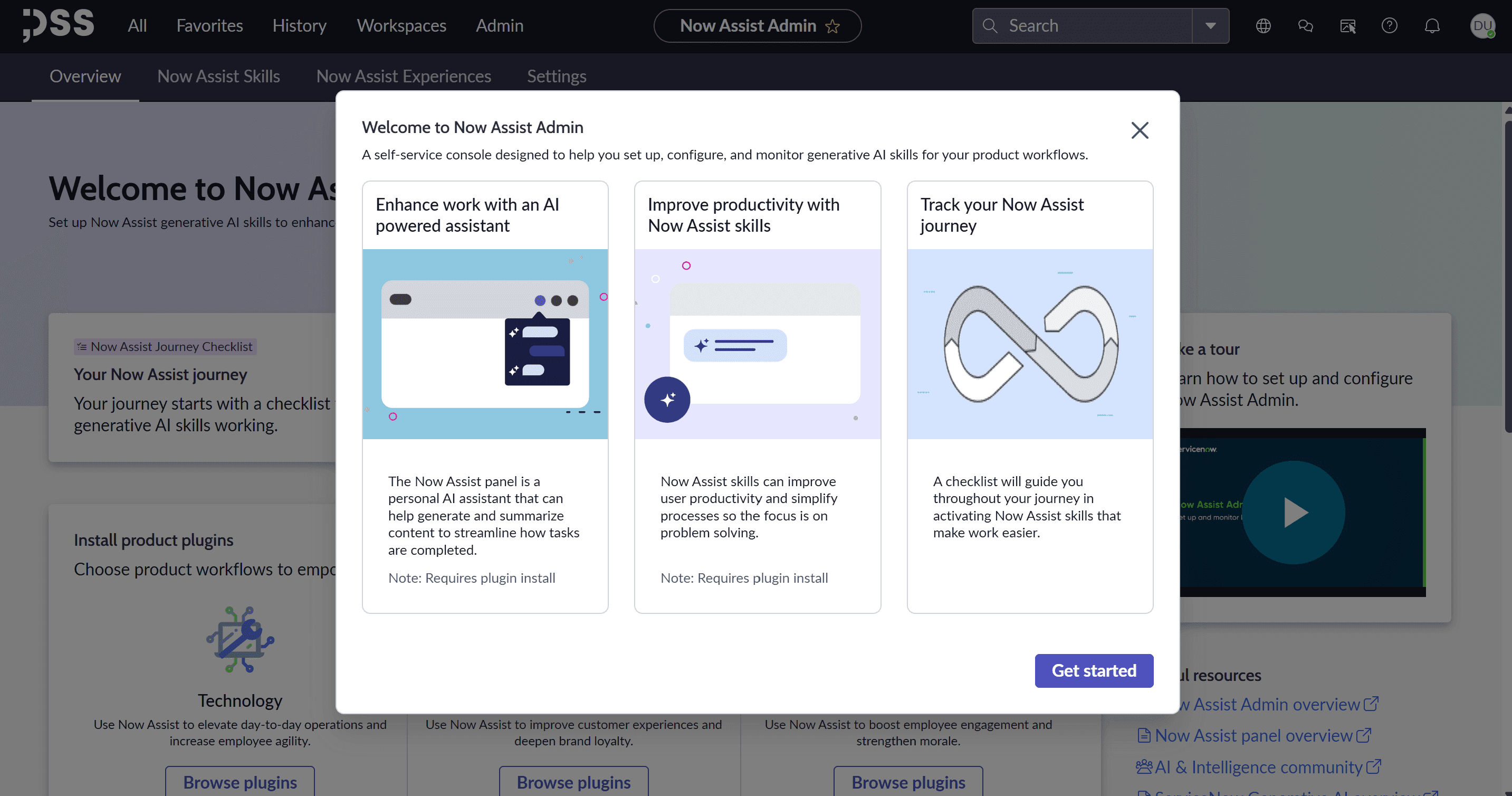
Now Assist administration is a good reminder that AI capabilities need to be configured, governed and monitored rather than treated as an unmanaged shortcut. See our article on Now Assist and generative AI productivity for the wider context.
3. Turn Documentation into Explicit OOTB Decisions
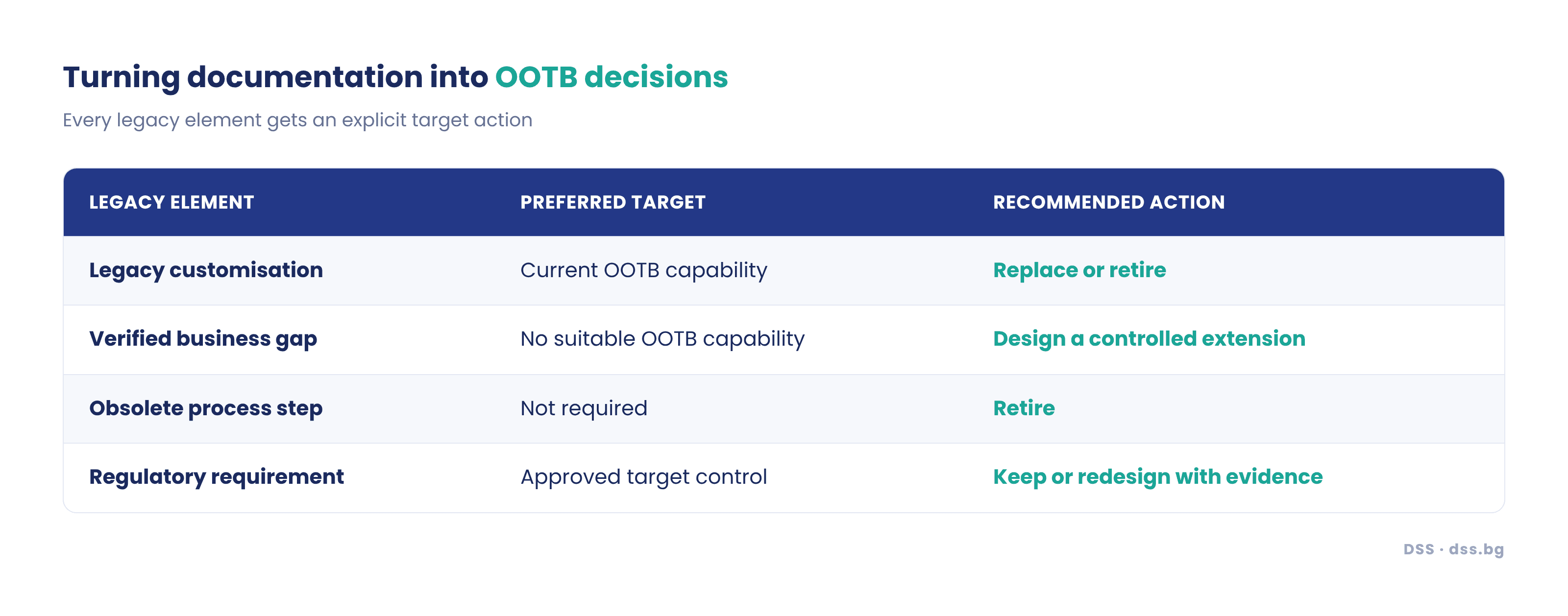
The current application is evidence, not the future-state specification. Review every legacy element and classify it as keep, replace, retire or redesign. Reuse OOTB capability wherever it satisfies the approved process. Extend the platform only when a verified business gap remains.
- Legacy customisation: where current OOTB capability exists, replace or retire it.
- Verified business gap: where no suitable OOTB capability exists, design a controlled extension.
- Obsolete process step: if it is no longer required, retire it.
- Regulatory requirement: keep it or redesign it with evidence against an approved target control.
A clean, well-modelled data foundation makes these decisions easier, as we explain in CSDM 5.0 explained.
4. Use AI-Assisted Creation as an Implementation Accelerator
Once the target design is approved, AI-assisted creator tools can help produce candidate tables, fields, flows, scripts, user experiences and tests. The instruction should be specific: generate only the extensions described by the approved gap analysis, inside the intended application scope and according to agreed naming and security standards.
This is where documentation becomes valuable beyond compliance. It acts as the controlled interface between discovery and build, reducing ambiguity in the prompt and making generated components easier to review.
5. Validate Engineering, Migration and Operations
Generated output is not production-ready by default. Review code and flows, test positive and negative scenarios, validate ACLs and roles, reconcile migrated data and confirm monitoring, support and rollback arrangements. Configuration, logic and data should be managed as coordinated but separately testable tracks, following the same software engineering discipline as any other platform change.
What Should Not Be Automated
- Approval of the target architecture or process.
- Decisions to retain or retire business controls.
- Security and privacy acceptance.
- Production deployment or destructive migration actions without change control.
- Claims about business value that have not been measured.
Organisation-wide oversight of these boundaries is the focus of our article on ServiceNow AI Control Tower and enterprise AI governance.
A Practical Starting Checklist
- Choose a bounded application with a known business owner.
- Define read-only evidence sources and data exclusions.
- Generate structured documentation with traceable references.
- Complete OOTB mapping and record keep, replace, retire and redesign decisions.
- Create only approved gaps using AI-assisted tools.
- Review, test, reconcile and obtain normal release approvals.
Use AI to Remove Friction, Not Governance
The strongest workflow does not ask AI to make every decision. It uses AI to accelerate evidence gathering and repetitive implementation while keeping architecture, security and release accountability with the people responsible for the platform. Learn more about our AI and machine learning services.
Talk to DSS about a controlled AI discovery or application-modernisation pilot.
FAQ
Can AI document a ServiceNow application automatically?
It can accelerate evidence collection and organise findings, but the result still requires review by platform, process and security specialists.
Should the new application reproduce all legacy customisations?
No. Each customisation should be compared with the current platform and retained only when it represents an approved requirement that OOTB capability does not meet.
Can generated components go directly to production?
No. They require the same scope, security, code review, testing, migration and release controls as other platform changes.
What is the best first pilot?
Choose a bounded, well-owned application with enough complexity to demonstrate value but limited enough for reviewers to validate the output thoroughly.
How should success be measured?
Agree measures before the pilot, such as discovery effort, review defects, duplicated customisation avoided, test coverage and migration reconciliation. Report only validated results.
How can DSS help with ServiceNow implementation?
DSS is an official ServiceNow partner providing consulting, implementation and managed services, including governed AI discovery, documentation and application modernisation.


